

It began as countless travel stories do: a moment of directional confusion in the labyrinthine heart of an ancient Medina. I was lost in Fez, a city designed to confound. Maps were useless; GPS signals bounced uselessly off centuries-old rammed earth walls. I stopped an elderly man, his face a map of sun-worn ridges, and asked for directions to a specific landmark.
His response was not to point, but to gesture with his hand to his heart. “Ahlan wa sahlan,” he said—literally meaning “family and ease,” the quintessential Arabic welcome. He didn’t just give me directions; he guided me through a maze of alleys only he could navigate. When we arrived, he stopped. “It is hot,” he stated matter-of-factly, gesturing to the midday sun. “My home is very close. You must have tea.”
Hesitance warred with exhaustion. In my own world, such an invitation from a complete stranger would be met with profound skepticism, even fear. People in modern metropolises barely know their neighbors; they certainly don’t invite strangers to their tables within five minutes of meeting them. Yet, in his eyes, I saw only a calm sincerity. I accepted.
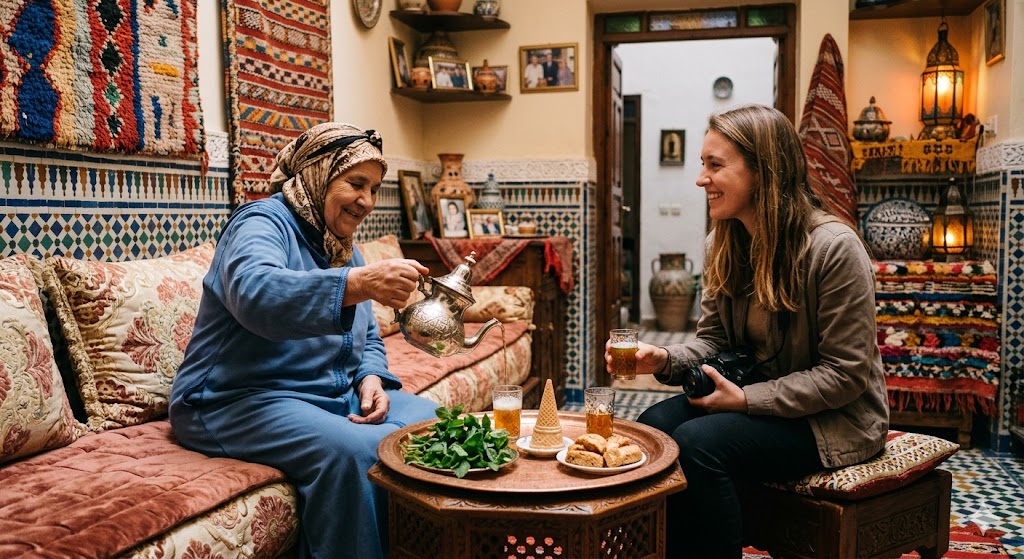
Ten minutes later, I was seated on a plush sdari (traditional sofa) in a cool courtyard, watching his wife carefully prepare a pot of Moroccan mint tea, the sweet, smoky aroma filling the air. There was a platter of Fekkas and Gazelle Horns (traditional pastries) that seemed to appear from nowhere. I was a stranger no longer; I was a guest.
That afternoon, sipping tea in that home, a fundamental question crystallized: In a world driven by transaction, speed, and guarded privacy, why do Moroccans—across cities, mountains, and deserts—still invite complete strangers to their tables?
The answer, I discovered, is profound. It goes beyond mere politeness or good manners. Moroccan hospitality is not a choice; it is a complex, centuries-old cultural, historical, and religious system. It is the invisible force that binds a diverse society together. It is an intricate dance shaped by the demands of desert survival, the ethics of Islam, the endurance of Amazigh traditions, and the requirements of community honor.
The First Shock: The Day a Stranger Became a Guest
My experience in Fez was not unique. It is the prototypical Moroccan story told by travelers for generations. It is the “first shock” of arrival—the realization that the transactional world you left behind has no jurisdiction here.
“Moroccan hospitality is about recognizing the humanity in the other person before anything else,” explains Dr. Amina, a cultural anthropologist based in Rabat. “We don’t see a ‘stranger.’ We see a potential guest. And a guest is a gift.”
This sentiment manifests in countless real-life examples that border on the surreal for outsiders. There are stories of travelers breaking down on mountain roads and being hosted by subsistence farmers who insist on killing their only chicken for dinner. Stories of people stopping for water and leaving hours later with their bellies full of couscous and a new “brother” in the family.
It is this unexpected, overwhelming generosity that first shocks a visitor, but what lies beneath this practice is a history of endurance.
The Ancient Origins of Moroccan Generosity
To understand Moroccan generosity, you must first understand the landscape that shaped it. Long before modern roads and airlines, Morocco was defined by ruggedness. The formidable spine of the Atlas Mountains separates the fertile coastal plains from the unrelenting grip of the Sahara Desert.
The Code of the Amazigh
The earliest inhabitants of this land are the Amazigh, often referred to as Berbers, a term they reject. They call themselves Imazighen, meaning “Free People.” For thousands of years, the Amazigh lived in autonomous, multigeneartional communities, navigating the harsh terrains of the mountains and desert. In such environments, helping a traveler was not an act of kindness; it was an act of vital survival.
“Where there is water, there is life,” is a local Amazigh expression. In the desert, a stranger approaching without being welcomed could be a hostile raider. But a stranger welcomed into the compound became a protected entity. Sharing your limited water and food was a form of insurance—you never knew when you might be the one lost in the next valley, dependent on the mercy of others. This “code of the desert” made hospitality an existential mandate.
The Caravan Routes
This mandate was further solidified by the trade routes that once pulsed through North Africa. For centuries, massive camel caravans loaded with salt, gold, ivory, and spices navigated the Sahara, linking sub-Saharan Africa to the Mediterranean. Chefchaouen, the famous “Blue Pearl” in the Rif Mountains, was once a fortified refuge along these treacherous paths.
The traders who navigated these routes relied on established hospitality stations. A city’s reputation, a family’s honor, and a region’s stability were measured by how securely they could host and protect travelers. This created an infrastructure of welcome that predates any modern hotel chain. Hospitality wasn’t just a virtue; it was the backbone of regional trade and diplomacy.
The Sacred Duty of Welcoming Guests
With the arrival of Islam in the 7th century, the ancient tribal codes of hospitality were given spiritual permanence. The ethics of welcome were transformed into a sacred duty.
Religious Influences
Islam places an immense emphasis on generosity and care for the traveler, the orphan, and the poor. The Prophet Muhammad is quoted in several hadiths (sayings) instructing his followers to honor their guests. One of the most famous states: “He who believes in Allah and the Last Day should honor his guest.”
In Moroccan family life, this is not a dormant theological concept. It is a living practice. Hosting a guest is viewed as an opportunity to earn Baraka—divine blessing. When you open your home, you aren’t just sharing food; you are inviting God’s favor into your household.
The Stakes of Reputation
However, there is also a potent social dimension to this generosity. Morocco is fundamentally a collectivist society, where family honor and community reputation are paramount. A family that gains a reputation for being tight-fisted (bkhil) shames not just itself, but its entire lineage. Conversely, a family known for its Karama (generosity) gains social capital and respect that cannot be bought.
“We host because it is our duty to God, but also because our name depends on it,” says Khalid, a shop owner in Marrakech. “If a guest leaves my house hungry or unhappy, I have failed my father and my grandfather.” This combination of divine command and social pressure creates a hospitality structure that is both spiritually motivated and socially enforced.
Why Moroccans Insist You Eat More
The core expression of this sacred duty is food. The sheer volume of food a guest is presented with is the primary source of cultural misunderstanding for foreigners.
You finish a mountain of couscous. You are full. You state, politely, that you cannot eat another bite. Your host smiles, nods, and immediately uses the specialized serving spoon to mound more food onto your plate, often with a playful “zid, zid!” (eat, eat!).
Common Foreign Misunderstanding: Foreigners often interpret this persistence as aggressive, manipulative, or even a challenge to their autonomy. They worry they are being rude by refusing, or they struggle to understand why their initial “no” was ignored.
The Moroccan Perspective:Food is the ultimate currency of affection and welcome. In traditional Moroccan culture, providing abundance is the deepest sign of respect you can offer. Insisting you eat more is not about ignoring your hunger signals; it is about communicating: “You are not a burden. We have enough. You are welcome. We respect you.”
“Sharing food is how we make al-Baraka (the blessing) grow between us,” explains Amina from Rabat. “When we eat together, from the same plate, we become connected. Refusing food is often seen not as a full stomach, but as a refusal of that connection.” To navigate this, travelers must learn the polite “false-refusal” dance—accepting a small amount, expressing immense gratitude, and gently placing a hand over the heart while stating “Alhamdulillah” (praise to God) to signify they are truly, gratefully full.
The Tea Ritual That Says More Than Words
If food is the expression of welcome, Moroccan mint tea is its vocabulary. You cannot enter a Moroccan home, office, or shop without being offered tea. It is known locally as “Berber Whisky” (a playful jab at the country’s prohibition of alcohol) or “Maghrebi Mint Tea.”
The History and Art
The tea itself is an art form, typically a combination of Chinese Gunpowder green tea, fresh spearmint (sh’ba), and a generous amount of sugar. The serving is a formalized ritual, a performance that communicates respect and attention.
The tea must be poured from a significant height, creating a foamy head (the “turban”) on the small glass. This height serves practical functions—it cools the hot tea, oxygenates the liquid, and demonstrates the skill of the pourer. The first glass is often the sweetest, the second more bitter, and the third soft—mirroring, as some sayings go, the stages of life.
The Social Significance
“The tea is a social contract,” says Dr. Amina. “It is how we slow down. You cannot drink tea quickly; you must sit. You must talk. The tea is the beginning of the conversation, the beginning of the negotiation, and the beginning of the friendship.”
In some southern and desert communities, the preparation of the tea itself must happen three times, each a slightly different blend, signifying “patience, strength, and love.” Refusing the tea is a major cultural taboo; it signals a desire to transactionalize the encounter and keep the host at arm’s length.
Hospitality Across Morocco: Regional Nuances
While the ethos of welcome is universal, the expression of Moroccan hospitality differs significantly across the country’s diverse geography.
Cities (Fez, Marrakech)
In the imperial cities, hospitality is often refined and multi-course. You are hosted in the intimate, highly decorated space of a Riad. The meal is a formal dance: mint tea and pastries, then a Tagine (slow-cooked stew), then Couscous, and finally fruits. It is structured, abundant, and designed to display the host’s culinary mastery.
Mountain Communities (High Atlas, Rif)
In the mountains, hospitality is rugged, immediate, and communal. Families often live in adobe homes clustered together. A guest might be invited to share a communal plate with several generations of the same family. The food is simpler—often based on local nuts, honey, goat cheese (Jben), and homemade bread. Here, the emphasis is less on formal service and more on shared presence and shelter from the mountain elements.
Desert Regions (Sahara)
In the deep Sahara, hospitality retains its ancient protective codes. The welcome is often nomadic, even in fixed communities. A guest is quickly offered water, dates, and fresh camel milk (a potent symbol of vitality). The tea ceremony is paramount, often performed sitting on carpets under the open stars. Here, the hospitality is often slower, more meditative, and focuses on the ritual of welcome.
The Dark Side of Hospitality Myths
The profound beauty of Moroccan hospitality has, unfortunately, led to some dangerous misconceptions among foreigners. It is essential to distinguish genuine cultural practice from transactional tourist experiences.
Common Misconception: “Everyone Wants to Host Me”
Debunked: In popular tourist hubs like Marrakech’s Jemaa el-Fnaa, people approaching you with an insistent invitation to tea, or attempting to guide you through the medina, are rarely acting out of ancestral duty. They are often “faux guides”—unlicensed guides who intend to charge you an exorbitant fee at the end of the “service.” Genuine Moroccan hospitality is rarely insistent in a transactional way; it is offered freely and respected if politely declined.
Common Misconception: “Hospitality Means Accepting Anything”
Debunked: This is particularly important for solo female travelers. While Moroccan culture is deeply respectful, a generic invitation for tea from a stranger on the street should be navigated with the same common-sense caution you would use anywhere. True hospitality usually takes place in a safe, family-oriented setting. Trust your intuition, and feel free to politely decline invitations that feel inappropriate or opportunistic.
Common Misconception: “Locals are Always Happy to Share Their Poverty”
Debunked: Foreigners sometimes view hospitality in Morocco through a colonial or exotic lens, admiring the generosity of people who have very little. While true that even the poorest will share, this perspective can trivialize their struggle. It is crucial to remember that this hospitality is often a significant financial sacrifice for the host. When you are genuinely hosted, always look for subtle ways to reciprocate—offer a high-quality pastry box, bring gifts for the children, or support a local initiative.
Is Moroccan Hospitality Changing?
This intricate cultural system is facing unprecedented modern challenges. Globalization, the mass tourism industry, urbanization, and social media are reshaping the Moroccan social landscape.
Urbanization and Speed
As more Moroccans move from communal rural life into individualistic city apartments, the physical and social spaces for traditional hospitality shrink. “In the city, we have less time,” admits Khalid from Marrakech. “People work long hours. The slow living that sustained the hospitality code is harder to find in Casablanca or Tangier.”
Social Media and the “Background” Host
“The biggest change I see is how hospitality is photographed,” notes Fatima, a university student in Rabat. “My parents’ generation hosted to connect. My generation sometimes seems to host to get the perfect Instagram photo of the tea pour and the pastries. It is becoming a performance rather than a feeling.” This shifting of focus from connection to representation is perhaps the most profound modern challenge.
Despite these pressures, the core remains. Younger Moroccans often express a powerful pride in their traditions, even as they adapt them. They may host in modern cafes rather than traditional riads, but the act of welcome, the sharing of food, and the Baraka of the guest remain central to their identity.
Lessons the Modern World Could Learn From Morocco
What can the rest of the world, often characterized by speed, guards, and screens, learn from the Blue Pearl of hospitality? Morocco offers a masterclass in human connection.
A community that values the stranger at its gate. A culture that prioritizes presence over transaction. A system that defines honor not by what you accumulate, but by what you share.
The Moroccan tradition of hospitality teaches that community is not just the people we know; it is the space we create for the people we do not know. It reminds us that trust is a social currency, and that sharing a meal from the same plate can melt the hardest cultural barriers. In a fast world, it provides a crucial space to slow down, to drink tea, and to simply be.
A visitor who comes to Morocco with an open heart doesn’t just see another country. They don’t just eat Couscous or climb mountains. If they are willing to step across that threshold and accept that first invitation, they will experience a profound, ancient lesson on what it means to be human. They will understand that in Morocco, a guest is rarely just a visitor—they become part of a story that began long before they arrived.