

Introduction: The City of Ochre and Emerald
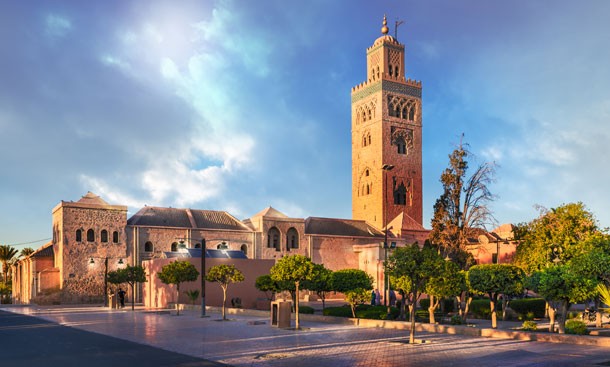
To understand Marrakech, you must understand its duality. On the surface, the “Red City” is a kinetic assault on the senses: the rhythmic clatter of calèches, the haze of grilling lamb in Jemaa el-Fna, and the labyrinthine intensity of the souks. But beneath this feverish exterior lies a city of profound, deliberate silence.
For centuries, the garden—or ryad—has not merely been a landscaping preference in Morocco; it is a spiritual and architectural necessity. In a city bordering the Sahara, a garden is a defiance of the desert, a manifest prayer for paradise (janna in Arabic, a word synonymous with “garden”).
As a cultural historian, I have spent years tracing the subterranean veins of this city. To walk these gardens is to read the history of Marrakech not in ink, but in water, tile, and shade. Beyond the crowded selfie spots lie sanctuaries where the air drops ten degrees and the sound of traffic is replaced by the murmur of fountains. Here is your expert guide to the hidden botanical soul of Marrakech.
I. The Lifeblood: The Invisible Miracle of the Khettara
Before stepping into the greenery, one must grasp the engineering marvel that makes it possible. Marrakech should, by all rights, be a parched plain. Its lushness is an inheritance from the Almoravids (11th century), who introduced the khettara system—a Persian-influenced network of underground canals.2
These sloping tunnels tapped into the water table of the High Atlas foothills, channeling cool water miles across the Haouz plain without evaporation. When you stand in a Marrakech garden, you are standing atop a thousand-year-old hydraulic grid that turned a military encampment into a garden city. Water here is not just scenery; it is power, history, and life itself.
II. The Icons: Reframed
While famous, these sites hold secrets often missed by the casual visitor.
Le Jardin Secret: The Saadian Revival
- The Context: Tucked deep within the Mouassine district, this site dates back to the Saadian dynasty (16th century) but was rebuilt in the 19th.3 It is one of the few examples of a great Riad-garden accessible to the public, meticulously restored to show the hydraulic genius of the past.4
- The Insider Perspective: Most visitors stay on the ground level. However, the true historian’s vantage point is the tower. Access is limited and requires an extra ticket, but it offers one of the highest views in the medina.
- Pro Tip: Go at “Golden Hour” (one hour before sunset). The light hits the zellige tilework of the pavilion and the distant Atlas Mountains simultaneously. Watch for the exposed sections of the original irrigation channels—archaeological proof of the complex water management described above.
Jardin Majorelle: Beyond the Blue
- The Context: Yes, it is the most visited site in Morocco.5 Created by French painter Jacques Majorelle in the 1920s and saved by Yves Saint Laurent, it is a masterpiece of Art Deco meets Moorish botany.6
- The Insider Perspective: The crowds can break the spell. The “Majorelle Blue” (a piercing cobalt) is seductive, but look closer at the botanical collection.7 Majorelle was an amateur botanist who corresponded with plant collectors worldwide; the cactus collection is scientifically significant.
- Pro Tip: Book the 8:00 AM slot (or the earliest available). For thirty minutes, you can hear the birds and the water—the way Saint Laurent intended it. Don’t skip the Berber Museum inside the studio; it houses one of the country’s finest collections of indigenous jewelry and textiles, curated with academic precision.8
III. The Royal Retreats: Where Locals Breathe
Leave the medina walls to understand the scale of imperial power.
The Agdal Gardens: The Sultan’s Orchard
- The Experience: Vastly larger than the medina gardens, the Agdal (meaning “walled meadow” in Amazigh) covers hundreds of hectares.9 Built in the 12th century by the Almohads, it functioned as a productive royal farm.10
- The Vibe: This is not a manicured flower garden; it is a working orchard of olive, orange, and pomegranate trees irrigated by massive basins (tanks).11 It is often closed to the public except on Fridays and Sundays (check local schedules as this fluctuates).
- Cultural Note: You will see few tourists here. Instead, you’ll find Marrakchi families picnicking under the olive trees. It is a place of “living heritage”—where the leisure habits of the 12th century continue today.12
The Menara Gardens
- The Experience: Known for its iconic green-tiled pavilion reflected in a vast basin, the Menara is the sister to the Agdal.
- The Insider Perspective: Skip the mid-day heat. The pavilion faces the Atlas Mountains.13 On a clear winter day, the snow-capped peaks frame the green pavilion—a visual metaphor for the water cycle (snow to stream to basin).
IV. The Avant-Garde & The Hidden: Modern Sanctuaries
For those seeking solitude and contemporary creativity, these lesser-known spots are the city’s current hidden gems.
Jnane Tamsna: The Literary Garden
- The Story: Located in the Palmeraie, this is the private estate of Meryanne Loum-Martin and her husband, ethnobotanist Gary Martin.14 It is arguably the most elegant example of modern “Moorish fusion.”
- The Botany: Unlike the rigid geometry of traditional Islamic gardens, the grounds here feel organic and wild. Gary Martin’s expertise shines in the water-wise gardening techniques (xeriscaping) that respect the local climate while creating lushness.
- Why Visit: It feels like visiting a sophisticated friend’s home. The food served here is often harvested directly from the organic plots on-site.15
Cactus Thiemann: The Desert Surrealist
- The Discovery: A surreal landscape located north of the city. Founded by Hans Thiemann, a German agricultural engineer who came to Marrakech in the 1960s (tired of growing cacti in greenhouses), it is now Africa’s largest cactus farm.16
- The Visual: Imagine 150 varieties of cacti, some towering 8 meters high, set against the terracotta earth and blue sky. It is sculptural, alien, and utterly silent.
- Access: Visits are often by appointment or restricted hours; it requires a short taxi ride but offers a profound disconnect from the city’s chaos.17
ANIMA: The Return of Paradise
- The Concept: Created by Austrian artist André Heller, ANIMA is a “fantasy garden” in the Ourika Valley.18 It blends sculpture, art, and botany.19
- The Experience: It refutes the idea that a garden must be purely traditional. Rodin sculptures and Keith Haring pieces peek out from behind bamboo thickets. It is whimsical, colorful, and surprisingly respectful of the local ecology.
V. The Traveler’s Toolkit: Practicalities
| Feature | Insider Advice |
| Timing | Gardens in Marrakech are best visited in the early morning (for birdsong) or late afternoon (for “golden hour” photography). Mid-day sun washes out the colors and flattens the architecture. |
| Tickets | Book online for Majorelle and Le Jardin Secret. For Agdal, ask your hotel concierge to confirm it is open (often only Fri/Sun). |
| Etiquette | In public gardens like Menara, public displays of affection are culturally frowned upon. Dress modestly to blend in with local families. |
| Hydration | While these are oases, they are dry. Carry water. At Le Jardin Secret, the rooftop café offers excellent nous-nous (half coffee, half milk) to recharge. |
Conclusion: The Garden as Mirror
To sit by a fountain in the Jardin Secret, watching the geometric shadows lengthen across the zellige, is to touch the heart of Moroccan culture. These spaces are not merely escapes from the city; they are the city’s ideal self—ordered, cool, private, and eternally life-giving.
In the end, the gardens of Marrakech teach us a simple, desert truth: water is precious, silence is a luxury, and beauty is a discipline.