

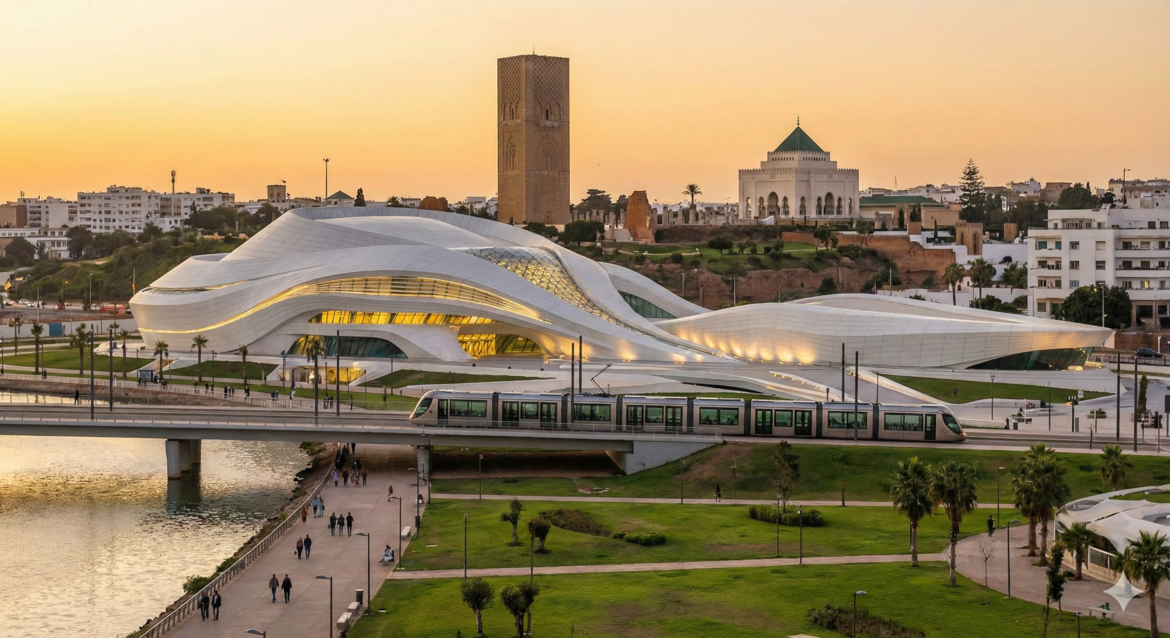
For decades, Rabat was the “Sleeping Beauty” of North African travel. While tourists flocked to the sensory chaos of Marrakech or the medieval labyrinth of Fez, the capital remained quiet, administrative, and—dare we say it—a little bureaucratic.
That era is over.
Recently named the very first African Capital of Culture, Rabat has undergone a metamorphosis that is nothing short of spectacular. It has shed its reputation as merely a government hub to emerge as a vibrant “Ville Lumière” (City of Lights). With the recently inaugurated Grand Theatre, a world-class modern art museum, and a green urban plan that rivals European capitals, Rabat isn’t just a stopover anymore; it is the continent’s newest cultural powerhouse.
Here is why you need to visit Rabat now, before the rest of the world catches on.
The “Zaha Hadid” Effect: A New Skyline on the Bou Regreg
If there is a single symbol of Rabat’s reinvention, it is the Grand Theatre of Rabat.
Officially inaugurated in late 2024, this architectural marvel sits on the banks of the Bou Regreg river like a futuristic white wave frozen in time. Designed by the late, legendary Dame Zaha Hadid, the theatre creates a stunning dialogue between the ancient and the avant-garde.
- The Architecture: The building’s fluid, curvilinear design mimics the flow of the river itself, avoiding sharp corners in favor of “liquid” geometry. It is a stark, brilliant contrast to the unfinished 12th-century Hassan Tower just across the valley.
- The Experience: This isn’t just a building; it is a cultural campus. With a 1,800-seat theatre and a 7,000-seat open-air amphitheater, it hosts everything from opera to Moroccan symphonic music.
- Why Go: Even if you don’t catch a show, walking the landscaped grounds at sunset—where the white curves of the theatre meet the golden light of the Atlantic—is a photographer’s dream.
MMVI: The Temple of Modern Moroccan Identity
For a long time, “Moroccan art” to the outside world meant carpets, ceramics, and zellige tilework. The Mohammed VI Museum of Modern and Contemporary Art (MMVI) changed that conversation forever.
Opened in 2014 and celebrating over a decade of influence, the MMVI was the first major museum in the kingdom dedicated entirely to modern art. This is where you go to understand the Moroccan mind, not just its history.
- What to See: The collection moves from the figurative paintings of the early 20th century to the abstract, rebellious works of the “Casablanca School” (featuring masters like Farid Belkahia and Mohamed Melehi).
- The Vibe: The museum feels cosmopolitan and fresh. It regularly hosts blockbuster international exhibitions—from Picasso to Delacroix—alongside local heavyweights, proving that Rabat is a serious player on the global art stage.
The “Green City”: Urban Zen and The Tramway
Travelers often brace themselves for the stress of Moroccan traffic. Rabat offers a refreshing antidote: Order.
This is one of the few cities in the region where the “Ville Nouvelle” (the modern city built during the French Protectorate) and the ancient medina function in perfect harmony, linked by a sleek, silent, and efficient tramway system.
- Eco-Capital: Rabat has been dubbed a “Green City” for a reason. Between the Exotic Gardens of Bouknadel (just north of the city) and the vast botanical trials of the Jardin d’Essais, the city breathes.
- The Walkability Factor: You can take the tram from the pristine Agdal neighborhood right to the walls of the Medina for a few dirhams. It’s clean, safe, and offers a window into the daily life of modern Moroccans—students, civil servants, and artists commuting in peace.
The Imperial Anchor: Where History Meets Future
Rabat’s modernity works only because it is anchored by deep history. The city is a UNESCO World Heritage site, not just for its monuments, but for the fusion of the modern and the historic.
You cannot understand the new Rabat without paying homage to the old:
- The Kasbah of the Udayas: A fortress within a fortress. Its blue-and-white walls and Andalusian gardens offer a quiet retreat overlooking the Atlantic. It feels like a mini-Chefchaouen, but with sea salt in the air.
- Chellah Necropolis: A hauntingly beautiful site where Roman ruins sleep beneath Islamic tombstones, all watched over by hundreds of nesting storks. It is a reminder that Rabat has been a capital of civilizations for two millennia.
If You Go: The Moroccofy Pocket Guide
- Stay: For authentic luxury, book a Riad in the Medina. For modern comfort, the Sofitel Jardin des Roses offers proximity to the new cultural districts.
- Eat: Don’t miss Dar Naji for traditional localized cuisine, or explore the hip cafes in the Agdal district for a “nous-nous” (half-milk, half-coffee) with the local intelligentsia.
- The “Secret” Spot: Visit the Mausoleum of Mohammed V at night. The guards are still there, but the crowds are gone, and the lighting on the gold-leaf ceiling is magical.
- Best Time to Visit: Spring (April-May) for the Mawazine Festival (one of the largest music festivals in the world) or October for pleasant weather and art gallery openings.
The Verdict: Marrakech is for the tourist who wants to get lost; Rabat is for the traveler who wants to be found. It is the face of the new Morocco—confident, creative, and undeniably cool.