
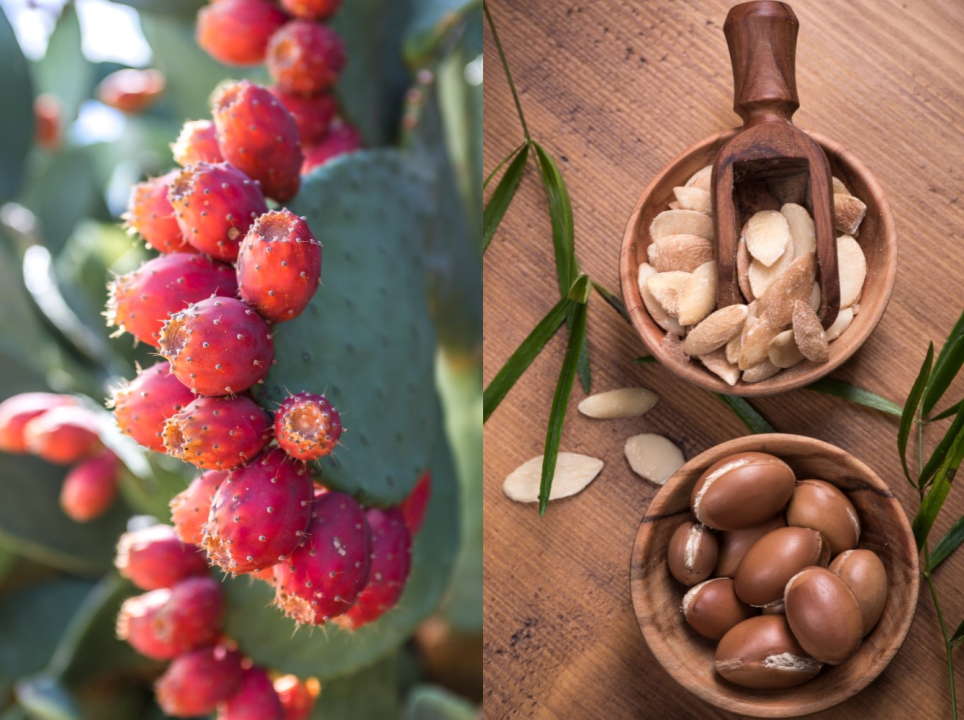
In the arid, sun-drenched landscapes of southern Morocco, survival is an art form. It is here, among the rocky foothills of the Anti-Atlas mountains and the sweeping valleys of the Souss, that nature has produced two of the world’s most potent skincare ingredients.
For decades, Argan Oil has reigned supreme as the global face of Moroccan beauty—a ubiquitous “Liquid Gold” found in everything from high-end serums to drugstore shampoos. But in recent years, a challenger has emerged from the humble cactus: Prickly Pear Seed Oil.
As a cultural historian and investigative journalist, I have looked beyond the marketing gloss to understand not just the dermatological differences between these oils, but the botanical, historical, and socio-economic narratives that define them.
The Veteran: Argan Oil (Argania spinosa)
To understand Argan oil, one must understand the Amazigh (Berber) soul. The Argan tree is endemic to Morocco, specifically the UNESCO-protected biosphere reserve in the southwest. For centuries, before it was a global commodity, it was a staple of the indigenous pantry—used for dipping bread, dressing couscous, and fueling lamps.
The Extraction Process
Traditional extraction is a rhythm of life in the villages. Amazigh women sit on the floor, cracking the hard nuts between two stones to reveal the kernels inside.
- Culinary Argan: The kernels are roasted before pressing, giving the oil a nutty, distinct flavor.
- Cosmetic Argan: The kernels are cold-pressed raw to preserve the fatty acids and vitamins.
The Profile
Argan oil is balanced. It is rich in Vitamin E (Tocopherol), phenols, and carotenes. Its fatty acid profile is roughly balanced between oleic and linoleic acids.
Best For:
- General hydration for hair and body.
- Acne-prone skin (due to its non-comedogenic nature).
- Sealing in moisture.
The Challenger: Prickly Pear Seed Oil (Opuntia ficus-indica)
If Argan is the “Liquid Gold,” Prickly Pear Seed Oil (often called Barbary Fig oil or Hindiyya in Darija) is the “Platinum.” While the cactus itself—introduced to Morocco centuries ago—is common, the oil derived from its seeds is the most expensive carrier oil on the global market.
The “Miracle” Economics
Why the high price tag? It is a matter of yield.
The Yield Ratio: To produce just one liter of Prickly Pear Seed Oil, cooperatives must process nearly one ton of fruit. Each fruit contains small, hard seeds that must be separated, washed, dried, and cold-pressed. It is an excruciatingly labor-intensive process.
The Profile
Prickly Pear is a powerhouse. It contains 150% more Vitamin E than Argan oil. However, its secret weapon is Vitamin K (rare in plant oils) and betalains (super-antioxidants). It also has a much higher concentration of linoleic acid (Omega 6).
Best For:
- Anti-Aging: The high Vitamin E content stimulates collagen production.
- Dark Circles: Vitamin K is known to brighten hyperpigmentation and under-eye circles.
- Absorption: It is a “dry oil,” meaning it sinks into the skin almost instantly without a greasy residue.
Head-to-Head: The Breakdown
To help you decide which indigenous elixir suits your needs, I have compiled a comparative analysis.
| Feature | Argan Oil | Prickly Pear Seed Oil |
| Texture | Rich, silky, slightly viscous. | Extremely light, “dry,” absorbs instantly. |
| Scent | Subtle nutty aroma (if unrefined). | Herbal, hay-like, slightly pungent. |
| Key Vitamin | Vitamin E (High). | Vitamin E (Highest) + Vitamin K. |
| Price Point | Moderate/Accessible. | Luxury/High (approx. 5x the cost of Argan). |
| Primary Use | Hair, Body, General Face Moisture. | Targeted Face Treatment (Eyes, Wrinkles). |
| Skin Type | Normal, Dry, Oily (Balances sebum). | Mature, Hyperpigmented, Sensitive. |
The Socio-Economic Heartbeat
We cannot discuss these oils without acknowledging the hands that make them. Both industries are driven by women’s cooperatives in rural Morocco.
Historically, the commercialization of Argan oil in the 1990s was a sociological revolution. It allowed rural Amazigh women to earn independent income, learn literacy, and gain status within their communities.
The rise of Prickly Pear Seed Oil has expanded this “pink economy” into regions where the Argan tree does not grow, such as the arid plains of Rhamna or the cliffs of Sidi Ifni. When you purchase authentic, cooperative-sourced oil, you are participating in a supply chain that keeps rural Moroccan villages economically viable in the face of droughts and urbanization.
Final Verdict: Which One Should You Choose?
The answer lies in your specific needs:
- Choose Argan Oil if: You want a versatile, all-purpose product. If you are looking to treat split ends in your hair, moisturize your body after a hammam, and maintain healthy skin, Argan is the reliable, classic choice.
- Choose Prickly Pear Seed Oil if: You have specific skin concerns related to aging or pigmentation. If you are battling dark under-eye circles, fine lines, or sun spots, the high investment in Prickly Pear is scientifically justified.
My Professional Recommendation:
Use them in tandem. Use Prickly Pear Seed Oil as your nightly facial serum (applied to damp skin) to target cellular regeneration. Use Argan Oil for your hair, body, and nails. In doing so, you engage with the full spectrum of Morocco’s botanical heritage.