
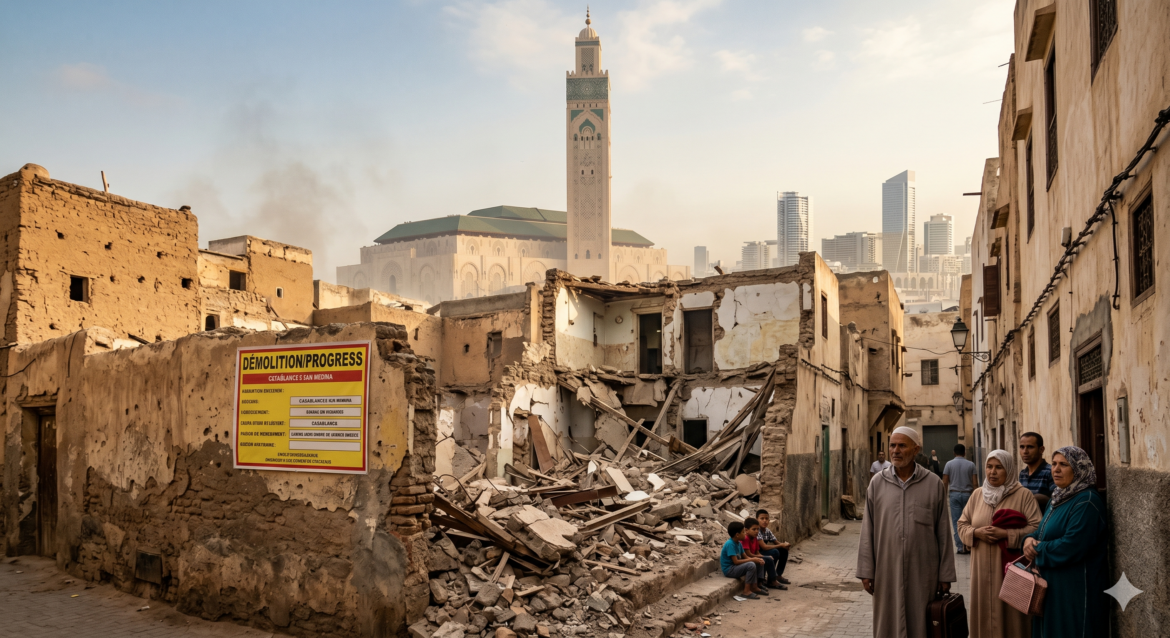
In the shadow of one of the world’s largest mosques, a centuries-old urban fabric is being dismantled — street by street, family by family. Morocco’s economic capital is remaking itself, but at what cost?
On a September morning in 2024, demolition crews moved through the narrow lanes of Casablanca’s Old Medina before many residents had stirred from sleep. By dusk, structures that had stood for generations were rubble. In one case, the family of the late activist Haj Ali El Manouzi discovered that a building adjacent to their historic home had been earmarked for destruction — despite, they say, a judicial report certifying its structural soundness.
“They gave us verbal notice the night before,” said Abdelkarim El Manouzi, who subsequently filed an appeal with the Administrative Court. “This is a legal overreach.” His family’s experience — swift, top-down, contested — encapsulates a drama unfolding across Casablanca’s oldest neighbourhood, where the ambitions of urban planners are colliding with the lived realities of a community that has called this labyrinthine quarter home for centuries.
A City Between Two Ages
The Old Medina of Casablanca — Dar el Beida in Arabic, the White House — predates the city that has grown around it almost beyond recognition. When the French established their protectorate in the early twentieth century and transformed a modest Atlantic port into Morocco’s commercial engine, they deliberately left the Medina in place, ringed by a European-built new city. That act of separation, intended to distinguish the “modern” from the “traditional,” gave the Medina its lasting character: dense, vibrant, and incrementally neglected.
Today, the Old Medina contains around 3,644 buildings, of which authorities have classified 792 as requiring total demolition. It sits at the edge of one of Africa’s busiest ports, adjacent to the Hassan II Mosque — the world’s third-largest, completed in 1993 with its 200-metre minaret casting a long shadow across the quarter — and is flanked to the west by the glittering Casablanca Marina, a luxury waterfront development that advertises a very different vision of the city.
The Medina’s position on this contested real estate, sandwiched between Islamic grandeur and Atlantic-facing glamour, is not incidental. It is, in many ways, the point.
The Boulevard That Would Not Die
The centrepiece of Casablanca’s transformation plans is the Avenue Royale — a grand boulevard conceived in the 1980s to link the Hassan II Mosque directly to Mohammed V Boulevard at the heart of the city. In September 2025, the project was finally secured with a 2 billion dirham investment and a completion target of 2029. Casablanca’s mayor, Nabila Rmili, called it “a historic moment,” describing a project that would combine “social resettlement, urban planning, and sustainable development.” Its ecological centrepiece is planned to be a 50-hectare urban park — the city’s largest green space.
But the Avenue Royale has been a “historic moment” before. It was announced in the 1980s, reconfirmed in 1993, restarted in phases in the 2000s, and has been intermittently delayed and contested ever since. A 2024 survey along its proposed route identified more than 1,730 structures classified as ruinous. The project is administered by SONADAC, the national agency for communal development, which has relocated thousands of families to peripheral suburbs — though the programme has long been criticised for poor planning. When 530 families were moved in the earliest phase in 1995, researchers from Hassan II University found that basic necessities — schools, health centres, parks — had not been incorporated into the receiving neighbourhoods.
The pattern has continued. Today, families displaced from the Medina are being offered roughly 9,000 dirhams in rental assistance and, in some cases, a payment of 10 million centimes to help find alternative housing. Residents have largely rejected these offers.
“We are not just losing a building,” one shopkeeper in the Bab Marrakech market told local journalists earlier this year, as the demolition of the Medina’s oldest market got underway on 2 January 2025. “We are losing everything — our customers, our suppliers, our whole way of life.” Traders were transferred to a temporary market on Rue Boucraa, near the mosque. The permanent replacement, officials say, will be rebuilt on two levels with underground parking, with modern hygiene standards. Some neighbouring merchants welcomed the facelift. Others were less certain.
The Language of Danger
Central to the controversy is a question of classification. Under Moroccan law, buildings designated as menaçant ruine — structurally dangerous — can be demolished by authorities without the same procedural safeguards that protect other properties. Critics allege that this designation has been applied too broadly, catching habitable homes in its net to accelerate clearance for the Avenue Royale.
A parliamentary question filed by Nabila Mounib of the Unified Socialist Party directly challenged the Interior Minister, Abdelouafi Laftit, over what she described as the “forced displacement” of Medina residents. Many families, she noted, had invested in renovating their homes and had technical assessments proving structural viability — yet still received demolition orders. “Some of these houses have only a few cracks,” a community spokesperson for a residents’ group told journalists. “To call them totally dangerous is not a technical conclusion. It is a political one.”
The community of Casablanca has allocated around 23 million dirhams for the demolition process, but the questions of compensation, relocation, and legal protection remain unresolved for hundreds of families.
Experts: A Heritage Without a Shield
Urban scholars have long noted that Casablanca’s heritage problem is structural — not merely a matter of political will, but of regulatory architecture. The city’s Master Plan for Urban Development, dating from the 1980s, acknowledged the historic value of the Medina. But acknowledgement was never backed by binding protection. As one analysis published in the Journal of Mediterranean Cities in 2025 observes, zoning plans for the Sidi Belyout district actually permitted increased building heights — effectively incentivising demolition and replacement. “The contradictions between strategic planning documents and regulatory instruments have opened the door to opportunistic land strategies,” the authors write. “This is not merely a market drift but the result of administrative arrangements that make speculation both possible and profitable.”
The heritage advocacy group Casamémoire has for years lobbied for stronger protections for Casablanca’s built legacy, though critics note the organisation’s focus has historically centred on the Modernist architecture of the French Protectorate era — the Art Deco apartment blocks and Beaux-Arts public buildings of the new city — rather than on the Medina itself. There is something uncomfortable, observers suggest, in a preservation movement that tends to privilege the colonial city over the pre-colonial one.
“The question of in whose interest this transformation is being carried out has never been properly answered,” said one urban sociologist familiar with the project.
The Global Comparison
Casablanca is hardly alone in navigating this tension. In Beirut, the post-war reconstruction of the city centre by Solidere, the private real estate company, was praised internationally for its ambition and criticised locally for erasing communities and replacing them with luxury developments largely inaccessible to the original population. In Istanbul, the clearance of historic Sulukule — one of the oldest Roma settlements in Europe — under urban transformation laws drew condemnation from UNESCO and human rights groups. Cairo’s attempts to “modernise” historic districts in Islamic Cairo have similarly produced a contested landscape of half-finished projects and displaced residents.
In each case, the pattern is recognisable: official urgency framed around safety or hygiene, classifications that expand the demolition footprint, compensation perceived as inadequate, and a future city imagined primarily for tourists, investors, and the middle class rather than for those currently living there.
The Future on the Drawing Board
What Casablanca’s authorities are proposing, in its best articulation, is genuinely ambitious. The Avenue Royale would create a monumental civic spine connecting Morocco’s most iconic religious landmark to its commercial heart, lined with greenery in a city starved of public parks. The Bab Marrakech market, rebuilt with modern sanitation and logistics, could serve the Medina’s traders more effectively than the cramped, ageing souk it replaces. The Marina and promenade projects extend a renewed Atlantic-facing identity that positions Casablanca as a destination city ahead of the 2030 FIFA World Cup, which Morocco will co-host.
The Casablanca-Settat region already accounts for roughly 32% of Morocco’s GDP and nearly half of all investment in the country. Infrastructure investment at this scale, its proponents argue, is an economic necessity, not a luxury.
But the history of the Avenue Royale — announced, delayed, restarted, and contested over four decades — suggests that grand blueprints and lived realities continue to diverge. As of mid-2025, authorities were still facing legal challenges and community resistance in the El Bahira area, where demolitions proceeded even as court appeals were pending.
A City in the Mirror
There is a photograph taken in any medina at dusk: the call to prayer echoing over low rooftops, tea glasses catching the last light, a child running between stalls. It is the kind of image that appears in tourism campaigns — authentic, timeless, marketable. What rarely appears in those campaigns is the notice on the door, the bare concrete of the relocation apartment forty kilometres away, or the trader who finds that his new stall, however modern, sits too far from the foot traffic he spent a lifetime cultivating.
Casablanca is a city that has always reinvented itself. It was a village before the French arrived, a protectorate capital before independence, a megacity before anyone had planned for it to be one. The Old Medina has survived all of these transformations — battered, neglected, but inhabited.
Whether it survives this one may depend less on the 2 billion dirhams earmarked for the Avenue Royale and more on whether the city finds the will to ask a question it has long avoided: who is the new Casablanca actually for?
Reporting drawn from official municipal announcements, parliamentary records, academic research, and local press coverage from 2024–2025.