
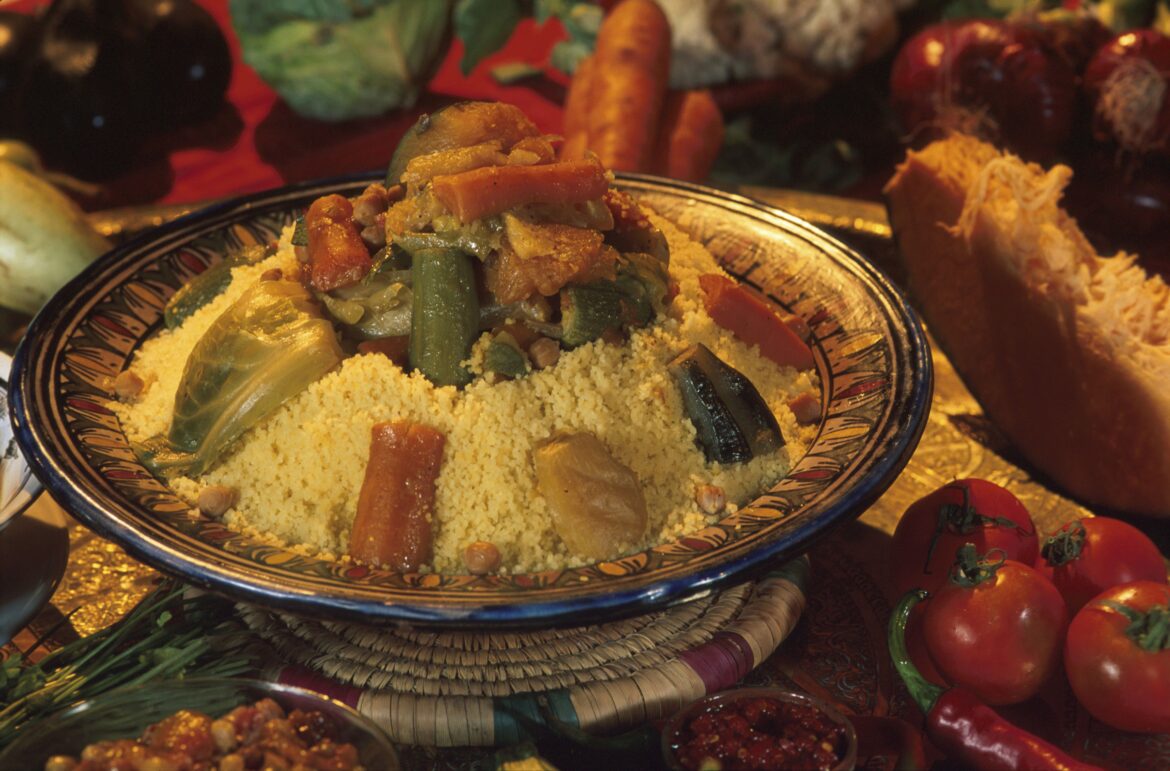
Walk through the medina of Fes, the boulevards of Casablanca, or the village paths of the High Atlas on a Friday just after the Dhuhr (midday) prayer, and the air smells the same: a fragrant, humid mix of turmeric, ginger, root vegetables, and the distinct, nutty aroma of semolina wheat.
This is the hour of the Friday Feast. But for the uninitiated, a grave culinary misunderstanding persists. In Western supermarkets, couscous is sold as “instant”—a grain to be drowned in boiling water, covered, and forgotten for five minutes.
To a Moroccan, this is not cooking; it is capitulation.
Authentic Moroccan couscous (seksu in Tamazight, kouskous in Darija) is never boiled.1 It is steamed. The difference is not merely procedural; it is the difference between eating wet paste and eating edible clouds. To understand why, we must look at the history, the physics, and the ritual of the couscoussier.
I. The Heritage: A Gift of the Maghreb
Historians and food anthropologists agree that couscous is a distinct invention of the Imazighen (Berber people) of North Africa.2 While pasta dried into hard shapes to survive long storage in Italy, the Maghreb developed a technique of rolling semolina flour with water to create tiny granules, which were then preserved or cooked fresh.3
Early evidence suggests the production of couscous pots dates back as far as the 11th century during the Almoravid dynasty, though the practice likely predates the written record. It is a dish born of agrarian ingenuity—turning hard durum wheat into a volume-heavy, texture-rich staple capable of feeding large families and entire villages.
II. The Physics of “Tafwar”: Steam vs. Boil
Why is boiling the enemy?
The Boiling Problem:
Couscous is pasta, but it is not macaroni. The granules are too small. When submerged in boiling water, the exterior of the grain gelatinizes instantly, sealing the starch. The result is a heavy, dense clump where the grains stick together. They become waterlogged rather than hydrated.
The Steaming Solution:
The Moroccan method relies on vapor. As steam rises through the grains, they swell slowly and evenly. The starch granules expand without dissolving into one another. This process, repeated two or three times with periods of aeration (fluffing) in between, coats each individual grain in a microscopic layer of moisture.
The result is fluffiness—grains that are separate, light, and capable of absorbing the flavorful broth later without turning into mush.
III. The Architecture of the Pot: The Couscoussier
You cannot make authentic couscous without the proper vessel. It is a piece of binary engineering:
- The Barma (or Gdra): The large bottom pot. This holds the water, meat, vegetables, and spices. It generates the flavor-infused steam.
- The Kiskas: The top steamer basket with perforated holes. This fits snugly over the Barma.
- The Qfal (The Seal): Historically, a strip of damp cloth dipped in flour paste was wrapped around the junction of the two pots to prevent steam from escaping. Today, a strip of plastic or aluminum foil is often used. If steam escapes the sides, the couscous dies.
IV. The Ritual: How to Steam (Step-by-Step)
This is the technique used by Dadas (traditional cooks) across the kingdom. It requires patience—roughly 2 to 3 hours.
Phase 1: The Oil and The Wash
Do not dump the dry grain into the steamer.
- Technique: Place the dry couscous in a large, wide platter (gsaa). Drizzle with vegetable oil and rub the grains between your palms (fatl) so every granule is coated.
- Hydration: Sprinkle with a small amount of water (or wash quickly and drain immediately). Let it rest for 10 minutes until the grains swell slightly.
- The First Steam: Transfer to the Kiskas atop the boiling broth. Allow to steam for 15–20 minutes after you see the steam piercing through the top of the pile.
Phase 2: The Aeration (The Critical Step)
This is where the amateur fails. You must dump the hot couscous back into the gsaa.
- Technique: Break up the clumps. Traditionally, this is done with hands, braving the heat, but a wooden spoon or whisk is acceptable for beginners.
- Hydration: Sprinkle liberally with cold water and salt. The grains are thirsty; they will drink this water.
- Rest: Let it dry for 10–15 minutes. The grains will separate and fluff up significantly.
Phase 3: The Second Steam
Return the grains to the Kiskas. Steam again for another 20 minutes (counting from when the steam escapes the top). The grains are now cooking through, becoming tender but retaining structural integrity.
Phase 4: The Finish (The Soul of the Dish)
Dump the couscous into the gsaa one last time.
- The Secret Ingredient: Now, you add a tablespoon of Smen. Smen is fermented, salted butter—the “parmesan” of Moroccan cooking. It adds an aged, cheesy, nutty funk that defines the flavor profile. If Smen is too strong for you, high-quality butter or olive oil is a substitute, though a Moroccan would call it a compromise.
- Texture Check: The grains should be distinct, amber-hued, and tender, with no crunch and no mush.
V. The Assembly: A Fortress of Flavor
Moroccan presentation is distinct from the “mixed” stews of the West.
- The Bed: The couscous is mounded on a large communal platter.4
- The Well: A crater is dug in the center.
- The Protein: The meat (lamb, beef, or chicken) is placed in the crater.
- The Walls: The vegetables (seven types is traditional: carrots, turnips, pumpkin, zucchini, cabbage, eggplant, tomatoes) are arranged vertically around the meat, creating a colorful fortress.
- The Moat: The rich broth from the Barma is ladled over the grains, just enough to moisten, with extra bowls of broth served on the side.
Conclusion
To steam couscous is to participate in a rhythm that has held Moroccan society together for centuries. It teaches patience. It rejects the “instant” nature of modern consumption. When you lift the lid of the kiskas and the steam billows out, filling your kitchen with the scent of the Maghreb, you are not just cooking dinner. You are honoring a civilization.
🥗 Sidebar: Regional Variations
| Style | Region | Distinctive Feature |
| Seven Vegetables | Casablance/Fes | The classic Friday standard. Savory, turmeric-rich broth. |
| Tfaya | Widespread | Topped with caramelized onions, cinnamon, raisins, and toasted almonds. Sweet and savory interplay. |
| Couscous Belboula | Atlas Mountains | Made with barley semolina instead of wheat. Earthier, nuttier, and heavier. |
| Saykouk | Rural Areas | Leftover plain steamed couscous served cold with fermented buttermilk (lben). A refreshing summer meal. |