
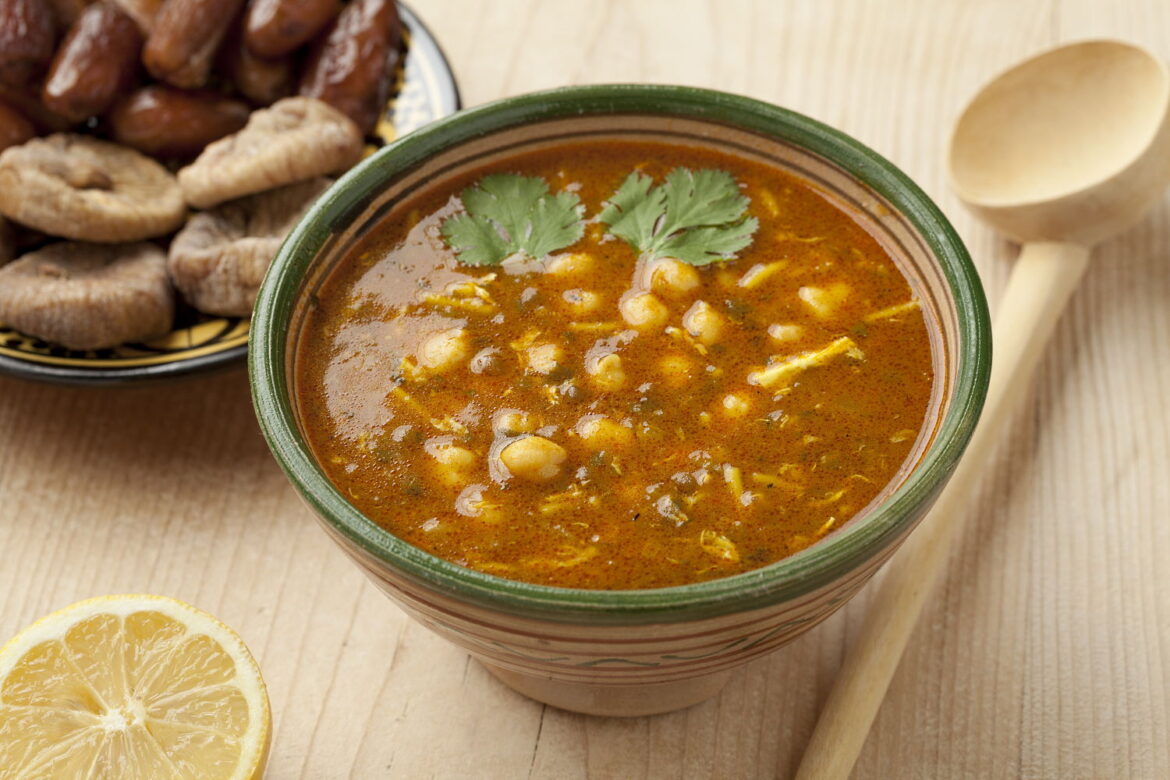
If you stand in the center of the Medina of Fez or the bustling boulevards of Casablanca at dusk during the holy month of Ramadan, you will witness a profound transformation. As the sun dips below the horizon and the cannon fires—followed immediately by the muezzin’s call to Maghrib prayer—the chaotic noise of the kingdom falls into a sudden, reverent silence.
In millions of homes, spoons are lifted in unison. The air, previously thick with the exhaust of rush-hour traffic, now carries a singular, unifying scent: the earthy perfume of celery, turmeric, and fermented butter. This is the hour of Harira.
While couscous may be Morocco’s ambassador to the world, Harira is its soul. It is a soup, yes, but to classify it merely as such is to misunderstand its gravity. It is a nutritional powerhouse, a hydration vessel, and a historical artifact in a bowl—a crimson, velvety embrace that signifies the comfort of home.
The Anatomy of a Masterpiece: The Base
At its heart, Harira is a study in texture and balance. While recipes vary from the Rif Mountains to the Sahara, the fundamental architecture of the soup remains consistent. It relies on a rich, sediment-heavy base that distinguishes it from the clear broths of the Middle East or the pureed bisques of Europe.
The foundation is built upon a “Holy Trinity” of ingredients that reflects Morocco’s agrarian history:
- The Legumes (The Earth):Harira is anchored by chickpeas (hummus) and lentils (laadas).1 The chickpeas, soaked overnight and often peeled of their skins, provide a buttery crunch, while the lentils offer a deep, iron-rich earthiness.2 This combination is likely a legacy of the Amazigh (Berber) influence, relying on hardy crops that could be stored year-round. They transform the soup into a meal, providing the protein necessary to replenish the body after a day of fasting.
- The Tomatoes (The Acid):A vast quantity of red, ripe tomatoes is grated or pureed to create the liquid volume.3 This provides the acidity needed to cut through the starch of the legumes. The addition of concentrated tomato paste deepens the color to a sunset red, a visual hallmark of a proper bowl.
- The Herbs (The Aromatics):If there is one non-negotiable ingredient in Harira, it is celery (krafes). While parsley and cilantro are used generously, it is the pungent, stalking bitterness of Moroccan celery (which is leafier and more intense than Western varieties) that gives Harira its signature nose.
Investigative Note: Historically, the integration of tomatoes is a relatively “modern” addition, arriving in the Maghreb with the Columbian exchange via Europe. Pre-16th century versions of this soup likely relied more heavily on broths thickened with grains and flavored with saffron and herbs, closer to the Hassoua (barley soups) still eaten today.
The Ritual of Tadouira and the Smen Secret
What separates a vegetable soup from Harira is the Tadouira. Derived from the Arabic verb “to turn” or “to rotate,” the Tadouira is a fermented mixture of flour and water (and sometimes yeast) added at the end of the cooking process.
The cook must pour this mixture slowly while stirring the pot continuously in a circular motion to prevent lumps. This technique creates the soup’s famous texture—silky, opaque, and coating the spoon. Linguistically, the word Harira itself is thought to stem from the Arabic word hareer (silk), referencing this luxurious consistency.4
However, the defining flavor profile comes from Smen.
Smen is salted, fermented butter, often aged for years in ceramic jars buried underground or stored in dark pantries.5 It has the pungency of a blue cheese or a high-quality parmesan. A spoonful of Smen added moments before serving melts into the hot liquid, imparting an umami depth that fresh butter simply cannot achieve. It is the distinct “funk” that signals authenticity.
The Table: A Study in Contrasts
In the Moroccan culinary philosophy, flavors are rarely isolated; they exist in conversation with one another. Harira is almost never eaten alone. It is part of a calculated nutritional and sensory ecosystem served at the Ftour (breaking of the fast).6
- The Sweet and Savory: In a pairing that often baffles the uninitiated, Harira is eaten alongside Chebakia—a sesame cookie fried in oil and drenched in honey. One takes a bite of the sticky, sugary pastry, followed by a spoonful of the savory, sour soup. The clash of textures and the balance of sugar and salt is electrifying.
- The Accoutrements: Dates are mandatory to spike blood sugar levels, while hard-boiled eggs dusted with cumin and salt provide additional protein.
Modern Evolutions and Regional Nuance
While the “classic” Harira is Marrakshi or Fessi in style (tomato-heavy with beef or lamb), regional variations tell different stories:
- Fez: Often lighter on the lentils but heavier on the Tadouira, sometimes using sourdough starter for a tangier finish.
- Oujda (The East): May feature more caraway or dried coriander seeds, reflecting proximity to Algerian cuisine.
- The Rural Atlas: You may find “Harira Beida” (White Harira), which eschews tomatoes entirely, relying on milk, broken semolina, and butter—a callback to pre-Columbian cooking styles.
Conclusion: The Vessel of Memory
To drink a bowl of Harira is to ingest the history of the Maghreb. It is the convergence of Amazigh agriculture, Arab seasonings, and the rhythmic cycle of Islam.
In a rapidly modernizing Morocco, where fast food and continental breakfasts are gaining ground, Harira remains an immovable pillar. It is the ultimate comfort food—a reminder that no matter how far one travels or how much the world changes, the smell of celery and ginger simmering in a pot will always lead the way home.